

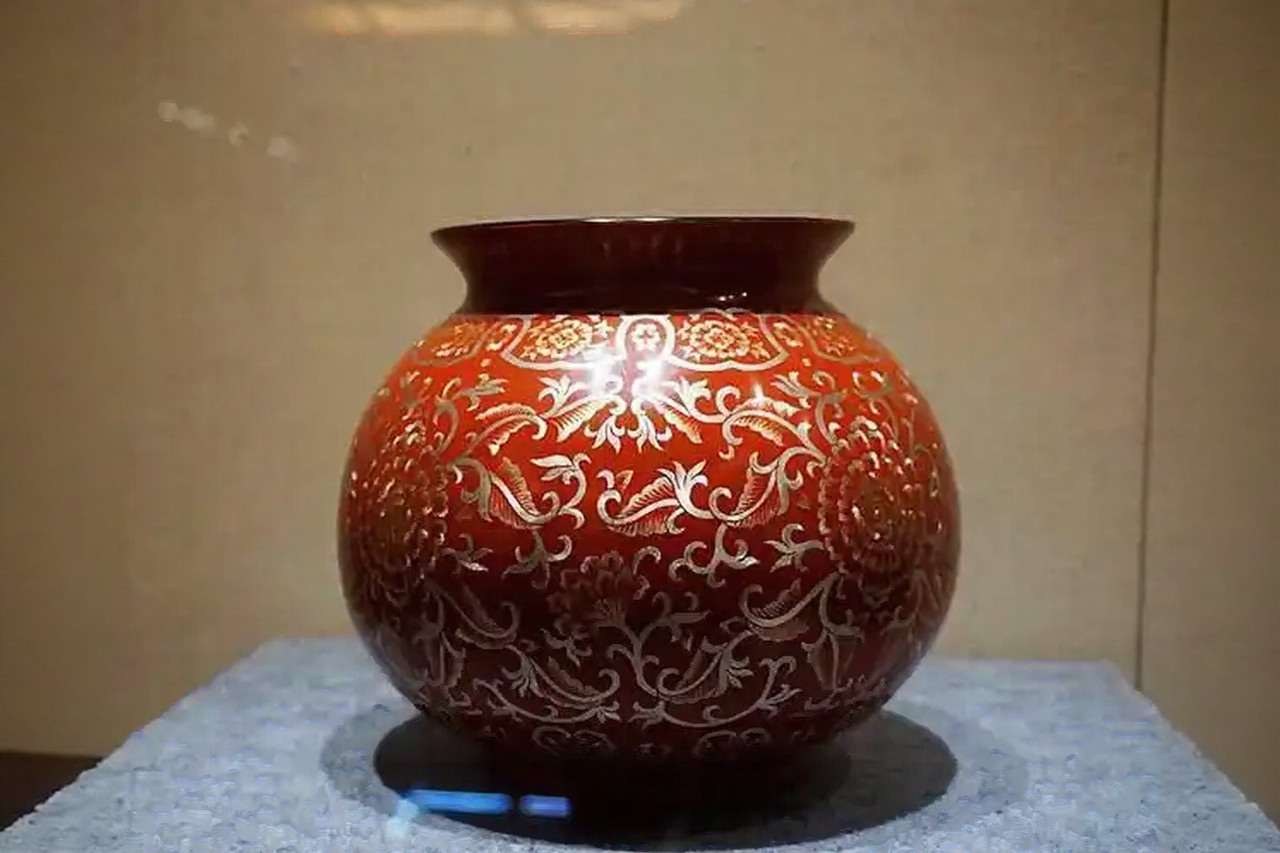
Chengdu, a city with a profound historical foundation, has given birth to countless brilliant cultural treasures. Chengdu Lacquerware is one of them. As one of China’s earliest centers of lacquer art, its development is like a magnificent scroll, carrying thousands of years of memories and cultural heritage.
Origins: The First Blossoms in the Shang and Zhou Dynasties
The history of Chengdu Lacquerware can be traced back over 3,000 years to the Shang and Zhou Dynasties. Lacquerware fragments unearthed at the Jinsha site, though weathered by time, still show vibrant, colorful patterns. Decorated on both the front and back in a symmetrical design, the lacquer has jade inlays that remain lustrous even after three millennia. These precious artifacts not only testify to the superb skills of the ancient Shu people but also mark the beginning of Chengdu Lacquerware. At that time, the ancient Shu people had already discovered the excellent anti-corrosion properties of natural lacquer and used it to create objects, forming the earliest incarnation of this craft.

Development: The Rise to Prominence in the Warring States and Han Dynasties
During the Warring States period, the Chengdu plain experienced rapid commercial and handicraft development. Lacquer art, as a major industry, was integrated into the production management system, leading to the establishment of the “Chengtian” institution to oversee lacquer workshops. During this time, Chengdu’s lacquerware techniques matured, and its production scale became renowned. The quantity and variety of lacquerware increased significantly, and advanced techniques like thin-bodied vessels and cloth-wrapped forms emerged. Decorative skills improved dramatically, with the development of bodiless lacquerware and inlaid clasps injecting new vitality into the craft.
The Qin and Han Dynasties marked the first peak for Chengdu’s lacquer art. The Records of the Grand Historian listed “the vermilion lacquer of Bashu” as a national specialty, and Shu and Guanghan prefectures became the country’s lacquerware production hubs. The lacquerware produced in Chengdu was incredibly diverse, including boxes, cosmetic cases, plates, winged cups, flasks, tables, and scroll containers. These items were often decorated with finely painted birds, beasts, and mythical figures. Inscribed pieces found in Han tombs across China, and even as far as Mongolia and Korea, bear marks like “Made in Chengdu,” “Shudu Zuo Lao” (Shudu Official Workshop), “Shudu Xigong” (Shudu West Workshop), and “Chengdu Jun Gongguan” (Chengdu Prefecture Official Workshop). These inscriptions vividly document the splendor of Chengdu Lacquerware during its golden age in the Han Dynasty.

Legacy and Evolution: The Ebb and Flow from the Post-Han Era to the Ming and Qing Dynasties
After the Han Dynasty, Chengdu Lacquerware gradually lost its absolute dominance nationwide but remained a significant production center. During the Three Kingdoms period, Chengdu and Guanghan were still centers of lacquerware production. At this time, Chengdu’s lacquerware, while inheriting the techniques of the Han Dynasties, also saw new developments. For example, lacquerware unearthed from a late Shu kingdom royal tomb in Chengdu in 2000, featured a wooden body coated in black lacquer with bright cinnabar red painted on top, showcasing a unique artistic style.
By the Five Dynasties period, Chengdu’s lacquerware with gold and silver inlays reached a high level of craftsmanship. Lacquerware excavated from the tomb of Wang Jian of the Former Shu kingdom in 1949 demonstrated superior design and carving, with a grand, unique, and meticulously crafted style that fully displayed the unique charm of Chengdu’s lacquer art during this period.
The Ming and Qing Dynasties saw Chengdu become one of the nation’s most famous production centers for carved and painted lacquerware. By this time, Chengdu’s lacquer techniques had accumulated to 14 different methods, with covered lacquer, gold tracing, piled lacquer, painted inlay, mother-of-pearl inlay, rhinoceros-hide lacquer, and engraved gold being the most prominent. Chengdu Lacquerware, with its exquisite elegance, luxurious beauty, fine luster, and brilliant colors, could either be hung in grand halls to showcase opulence or serve as delicate and durable household items.

Modern Challenges and Revival
In the late Qing Dynasty and early Republic of China, Chengdu’s lacquer art fell into a state of decline. Although the government established various craft workshops to train lacquer artisans, it was difficult to restore its former glory. During the War of Resistance Against Japanese Aggression, there were over 50 lacquerware workshops and shops in Chengdu, employing more than 300 people. Three streets—Kejia Alley, Small Kejia Alley, and Taiping Street—became dedicated centers for producing and selling Chengdu Lacquerware, and famous workshops like Ruichang and Tongfa emerged. However, due to national instability, these workshops gradually closed before the founding of New China, and many artisans were forced to change professions.
After the founding of New China, Chengdu Lacquerware found a new opportunity for development. In 1954, the Chengdu Arts and Crafts Cooperative was established, followed by the Chengdu Lacquer Cooperative in 1956, which steadily expanded its technical staff. In 1960, the Handicraft Cooperatives opened the Chengdu Arts and Crafts Technical School, offering classes that trained a new generation of artisans. However, between 1963 and 1973, Chengdu’s lacquer art faced setbacks, with production almost at a standstill. In 1975, authorities decided to revive production, with senior artisans leading apprentices in lacquer techniques, ensuring the comprehensive inheritance and protection of the craft that had been lost for many years. In 1999, however, facing the impact of the market economy, the Chengdu Lacquerware Factory once again struggled, and it wasn’t until 2000 that production of traditional Chengdu Lacquerware was restored out of a deep sense of historical responsibility for the craft’s legacy.

Inheritance and Innovation in the New Era
On June 2, 2006, Chengdu Lacquerware, along with Shu Brocade, Shu Embroidery, and the Qingming Water Releasing Festival of Dujiangyan, was added to the first batch of the National Intangible Cultural Heritage List. This recognition injected new momentum into the inheritance and development of Chengdu Lacquerware. Today, in this new era, Chengdu Lacquerware is both preserving its traditional techniques and actively innovating, blending modern design concepts with ancient craftsmanship. This has led to a series of lacquerware products that are not only rich in traditional cultural charm but also appeal to a contemporary aesthetic. A growing number of young people are now showing interest in and learning Chengdu lacquer art, bringing fresh life to this ancient skill. With the dedication and innovation of its inheritors, Chengdu Lacquerware is sure to shine even more brilliantly in the future, continuing its millennial legacy.
